This is part 5 of 8 of The Singing Ape
5
When the rain came, Vivienne and Pete had already found a miraculous kind of shelter. The statue they’d discovered stood on a path of colorful bricks that was mostly buried, but once they discovered its outline, marked by where the trees grew and did not grow, they followed it to a row of foliage-covered buildings. Peeking inside the first one, Vivienne saw a scene she recognized from historical livplay: an amusement ride waiting for people to climb aboard.
“These are entrances to ‘rides,’” Vivienne told Pete. “A kind of entertainment from before livplay and gameworlds, from before the ConneX.”
“Yes, I know rides,” Pete said. “We still have them in the City of Towers.”
“You do? I would love to see that!”
“We do not show outsiders. We feel shame, that we still have such ancient toys and games, that we are so far behind the rest of the world. But I will take you,” said Pete, “when we escape this madness.”
Vivienne took his hand. “They built these rides on this brick path, across from what used to be a lake it looks like,” Vivienne said. She pointed across the roadway which opened onto a low muddy plain.
Pete shook his head, “This land is frequently taken by sinkholes,” he said. “I believe that is what we’re looking at. There, in the water you can see the tops of other buildings, perhaps other rides which have been swallowed into the pit.”
Lightning flashed and a great boom filled the air all around them. “Come,” she said, taking Pete’s hand. “Let’s go back here, where it’s dry,”
They encountered several lines of tattered ropes and Pete took the lead: “these are to organize the people into a single line, so they can get on the ride one at a time. Come, we’ll walk to the front.”
He seemed to know exactly which way the path would turn and they passed through the folds and convolutions quickly. At the front they found a line of cartoonish cars, constructed with bench seating so people could get on and off quickly, and so people of every size and shape could pile on together. “This looks like fun!” Vivienne said, and immediately requested this scenario from the livplay server, forgetting that she had no connection, that her request could not be received let alone satisfied.
“We have something similar in the city,” Pete said, stroking one of the cars. “We call it The Wild Ride of Monsieur Toad.”
“Monsieur Toad!”
“It is a very old ride. No one knows what the name means.”
“I’m sure that the name evolved from a sensible root whose meaning was lost, like how there is a city called in English, Toad Suck.”
“Perhaps. So if electricity worked here as it does in the city, this would be the controls — the operator would push these buttons and…” Pete pressed the green button labeled “ride main,” which snapped into place with a firm click. Nothing happened. He pushed a few more buttons. The sound of rain falling echoed all around them.
“It’s too bad. It looks like a fun ride,” Pete said, looking down the tracks.
“Let’s walk it,” Vivienne said suddenly. “We’ll come back if it gets too dangerous. But let’s follow these tracks and see where it goes, what this ride is like.”
Pete looked out towards the gray muddled daylight. There was a series of flashes and booms, rolling thunder. He thought of his brother, Skip, such a gentle, timid man, how he even feared the daily rain.
“We should go back. We left them to look for poachers. They do not know we have found the Magic Kingdom. They will think we are in danger.”
“You worry for your brother.”
“Of course.”
“He is with Sofi and Pierre. They have guns and Sofi is fearless. They will protect him. Let us explore just a little, and then we will return to camp.”
“He is safe and dry in a tent with your students,” Pete said. “They will distract him with their endless speculations about the gorillas, stories of how the beasts came to Florida.”
She laughed. “I hope you are not already bored with the talk of primatologists.”
He turned towards Vivienne, whom he wished to love, and took her hand. “Yes, this will be fun. Let’s follow the tracks and find our wild ride.”
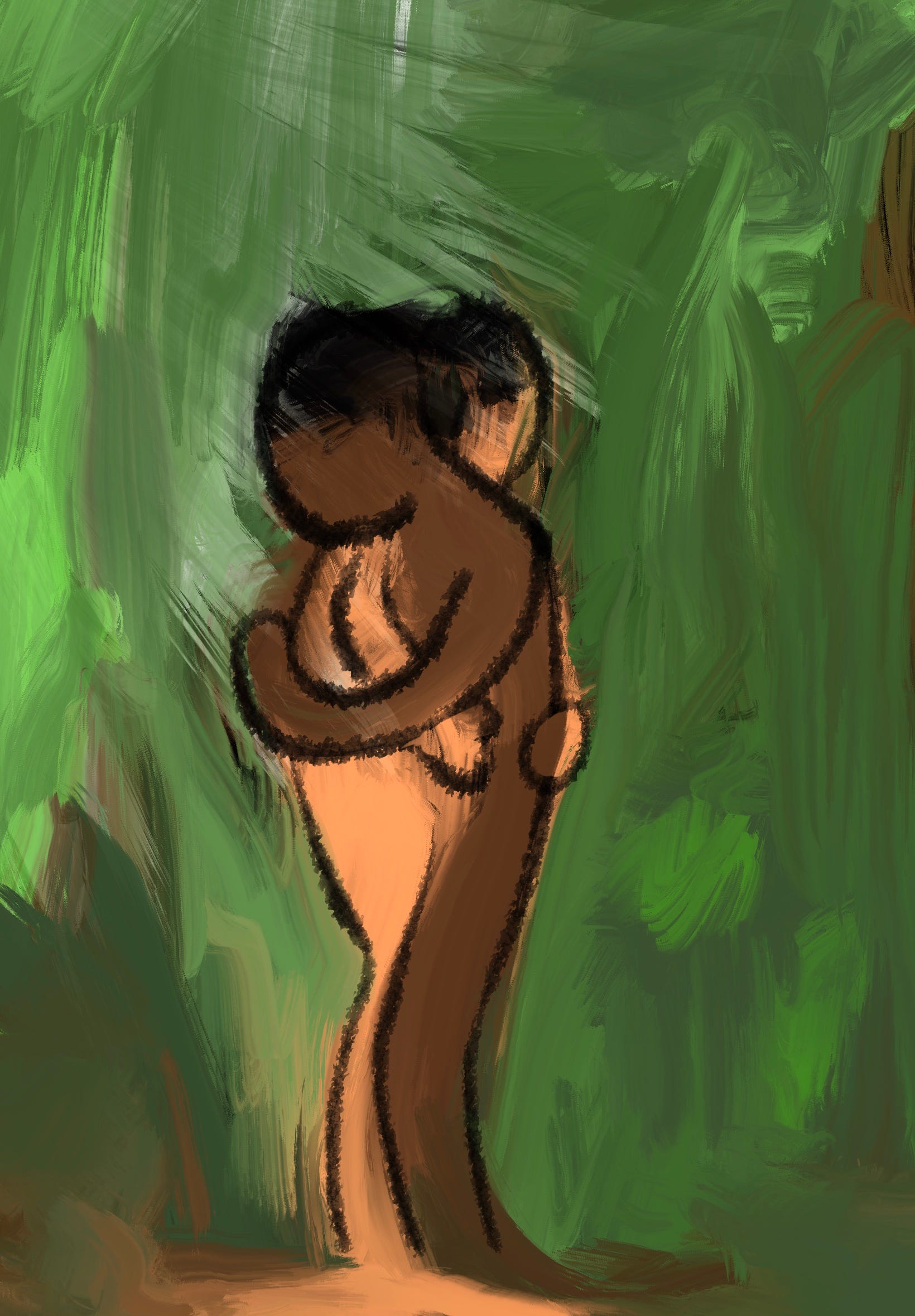
Pete kept a watertight box of matches with him always, and now as they prepared to explore this strange, ancient Mr. Toad, he pulled them out and set them on a counter. He took off his shirt, revealing his lightly muscled torso, dark as the ocean at night and shining where the gray daylight fell upon its contours. Then he rolled the shirt and climbed beneath the ride cars and began mopping.
“Are you cleaning, Pete?” Vivienne asked him, amused but certain there would be an explanation.
“There are petroleum products — lubricants — on the wheels and tracks. I’m going to get as much of it onto my shirt as I can, so we can use it as a torch.”
“You men of the City of Towers have such useful skills.”
“When things don’t always work easy, you learn to make them work hard,” he said. After a few minutes he rose up, grease-streaked and wielding a twisted, blackened shirt. Searching around the control panel he found a long pole with a hook at the end of it, and wrapped the shirt tightly around it. Then he pulled out a match and lit his torch. It gave off a steady, smokey light.
“Now let us find Monsieur Toad,” he said, smiling.
“I’m surprised these rides and buildings survived the war,” Vivienne said as they crept through the first dark archway.
“The fighting was in the city, and the villages. We are far out, here, where few ever come.”
The torchlight illuminated a playful stage set of flat cartoon animals, larger than life and wearing alarmed expressions.
“I think in this ride the creatures are afraid of you,” Pete said. “Yes, look at the tracks — the cars will move erratically. These animals are fearful, and jump out of your way — or perhaps don’t, perhaps you hit them.”
“You were there, you fought in the war, didn’t you Pete?”
“I didn’t fight. I survived. I was taken, along with my father. My mother and Skip were left defenseless. War takes a man from the things he loves and forces him to fight and die for the hatreds of another.”
“A corruption of the natural order.”
“You understand, Vivienne.”
She hesitated, but could not resist. “I shouldn’t compare your real war to my livplay experiences. But they are real-feeling, and authentic. The game designers research it down to the smallest element. The most moral use of livplay really is that it allows us all to experience the lives of others — expanding empathy.”
“How long did you play this game?”
“Almost a year.”
“Our war lasted only five months, but felt much longer.”
“As I said, it is not the same.”
“Tell me the horrors of your dreamwar, Vivienne whose heart overflows with empathy.”
Vivienne heard in his voice something between impatient contempt and indulgent love. But it was important to her that Pete know all the corners of her life. She wished to bring him home to Quebec and share everything with him, get him connected, let him in her mind, and be in his.
“I’ll tell you this. Many people died during that year. They were not really dead, but they were dead to the game, and there is no way of getting them back, and you have to go on without them. And you love them, even though you know it is not real, you still love them. I felt that pain so many times as the war raged on. But the hardest thing for me was when I died. It was knowing that my loved ones felt this pain now because of me. It was knowing that they had to keep going, they had to carry on, without me. And I couldn’t help. I had only one life to sacrifice for the cause, and when I had given it, it was over.”
“War makes people disappear,” Pete told Vivienne. “That can be good or bad. It depends on the person. The war took our mother and our father. For my family, that is what the war got wrong, and right.”
“You don’t mourn your father?”
“I would, if I knew he was dead. But it seems just as likely he would leave. When you burn the earth, you make it possible for new things to grow there. He hated living in the city. I imagine him with a new, younger wife and every year a new young son. Raising goats. He liked goats.”
“That’s nice to think,” said Vivienne.
“Or I imagine his skeleton in the mud of a roadside ditch,” Pete said, and shrugged under his torchlight. “I imagine both just as much. Perhaps this is the biggest difference with your livplay. When your friend disappears, you know what happened.”
“It’s true. Game data is always accessible to active players. I could always find out if someone died, and how.”
“And if they were dead, you knew they were alive, somewhere in the world.”
“Yes, alive and unhappy, because they’d been removed from this game we all loved.”
“Here is another difference: war is not a game anyone loves. When I imagine my father’s skeleton in the mud, it is not entirely sad. For I can hope that he died before he was forced to do terrible things, that he died before he could learn what happened to his wife and children. I imagine he died innocent. Which is terrible but not as terrible as surviving by doing inhuman things, and living on fit for nothing but killing, like the poachers who murder gorillas because they miss the days of murdering men.”
They approached a doorway blocked by a ride car, and Pete and Vivienne pushed it. As the car advanced, a wooden panel popped out from beside them. They both yelled out.
“It’s a dog!” Pete said, holding his torch closer to the panel. “A frightened dog. It’s part of the ride.”
“How did it work, without electricity?”
“We have mechanisms like this, in the City of Towers. Non-electric. The car must push a lever when it passes through the door, and that makes the dog appear. Watch, I’ll bet…” Pete got behind the car and pushed it the rest of the way through, which made the dog panel retract into the wall. “Yes, it turns a wheel as it passes and that pulls the panel back, reloading the spring. It’s a non-electric machine.”
Vivienne marveled at the mechanism. “Huh!” she said. “A non-electric machine! Who dreamed such things were possible?!”
Pete laughed. “Your livplay game designers should build a game of the Fruit Forest, the Sea of Houses, even the City of Towers — a game made of our humble Eye-for Corridor. You Canadians will all play it, and be amazed!”
“They should, Pete! You’re absolutely right, they should!”

The right side of Sofi’s body would go numb then rage again with pain. Still she focused on her goal: she stepped through the spinning masses of robotic puppet children dragged round and round on their mechanical tracks. Her left leg burned now too, because it had borne all her weight since she fell through the ceiling of this ancient entertainment chamber and began hopping around, looking for way out. The last option seemed to be the door on the other side of the fake river, which promisingly had “EXIT” in bold red English-language letters written over it. Still, she had to get there.
She reached the edge of the river and looked down at a sunken boat. It was only an inch or two beneath the surface of the brownish water. She ruled out hopping onto it using her one good leg: if her foot slid she would have no way to catch herself, and if her foot landed firmly, she might plant it straight through the corroded old thing and become trapped. No, she needed to get low to the water and creep onto the bow gently, then roll to the other side and climb off. She sat at the water’s edge, the recording still looping: “there is just one moon. And one golden sun. And a smile means . . . There is just one moon. And one golden sun. And a smile means . . .” She stretched her left foot forward to test how strong the boat was when something large and menacing moved smoothly just under her. Heart in neck she rolled backwards right into one of the lines of dancing dolls. They knocked her forward again and she landed with her face inches from the water, where she was able to see several tadpoles and gnats and a school of small fish and the eyes of one very large alligator rising to the surface. She pushed herself backwards again as it broke the surface and opened its jaws, but the beast couldn’t crest the angled lip of the fake river and it slipped back. This time she grabbed hold of the dancing child dolls and let the machine drag her. When it spun her farther from the river she let go and sat between the sets of little singing puppets and driven half-mad by pain and irony, she realized she’d never felt so alive. She laughed, “Oh yes!” she yelled, “Fucking alligators!” she announced, “This is the good shit!” She knew she sounded like a maniac, but it was so darkly funny she couldn’t help but glee. All her life she’d livplayed scenarios like this, sought them out, always pushing to find something more intense, more extreme, and now she was trapped in a pit with these singing spinning grotesqueries, with no way to call for help, alligators between her and a door that might lead nowhere, with no gun and half her body shattered and in pain. “Brang it ooon!” she growled in the voice of her favorite perpworld character, an enormous sweaty Californian bursting with muscles. Then she rolled on her side and laughed.
She must have passed out like that. Because when she looked up again, a great deal of time seemed to have gone by. It was raining even harder now, and she lay in water flooding a quarter inch, soaking her back and the base of her hair, and flowing across the platform of spinning dolls towards the river. The hole she’d fallen through was now a sort of square waterfall, pouring water and dirt and leaves and frogs down on the spot where she landed what seemed like ages ago. The river entered and left the room through vast openings that were pitch black and obviously full of water, and she wondered just what kind of volume this fake river could hold, how long it must rain before the water level would rise enough to allow an alligator to climb out.
“It’s clear I need another plan.”
She got to her feet and hopped back to the control room so dizzy from pain and injury she felt almost drunk. “So I turned you on,” she said, “but you do more than just turn on. Let’s see.” She pushed a button that killed most of the lights, just leaving a few theatric spotlights. She pushed another that knocked the soundtrack out of its loop, “friendship to everyone, though the mountains divide and the oceans are wide, it’s a small world after all…” She tried pushing that one again, and then its neighbors, to see if she could turn the sound off completely, but the song still played. She saw a big toggle switch labeled in English “ride main forward stop” and went ahead and switched it. The noise was horrible — she had to go out into the rain-flooding room to see what was going on, and it took her a minute to figure out what she was seeing, but the boats that were underwater were also attached to tracks, and they were now moving forward on those tracks, slowly shoving aside mud, branches, and the half-rotted trunk of a palm and headed into the dark unknown at the end of the room. One of the two broke apart as it moved, but the first one held together, an eerie underwater ghost boat disappearing into darkness. As it vanished from view another boat entered from the other side of the room. This one was entirely above the waterline, bobbing merrily as a chain dragged it from beneath. It also looked fresher than the others, probably because it had seen less sun, but its cheerful pink bow was decorated with the desiccated remains of a muscovy duck.
“Fifi, move,” she said. “Fifi, move!” she yelled. And she moved: she jog-staggered out the door, then ran-hobbled to the edge of the river about four feet ahead of the boat. She looked down and saw nothing lurking. The movement of the track should scare any reasoning beast into hiding, she thought, but she was unsure how reasonable these great reptiles might be. When the boat came to its nearest point, she leaned forward and grabbed its handrails and swung into the plastic bench seat. She scooted to the other side of the boat and lifted herself up with her left arm, then used her left leg to push herself forward. She only reached the edge of the platform, her legs splashing into the water, and she panicked and kicked and pushed and pulled herself up, and when she looked back down at the water, there was nothing there. She was now on the opposite stage set, and the boat with its muscovy corpse passed out of the room and into the adjacent blackness, grinding against broken pieces of fiberglass.
The door that said “EXIT” was just a few feet away, and the adrenaline was still flowing through her muscles and veins. She staggered towards it, elated, hopeful, feeling like she was about to “win” — a strange feeling she half-scolded herself for: this is not livplay, Fifi! But it was the truest feeling in her: from her probably-concussed head to her probably-broken toe, she felt the thrill of succeeding in gameplay. She pushed the door’s release lever and it swung forward into a hall made of white-painted concrete block. Low emergency lights were on, and Sofi stopped to marvel again at this: electricity! In the Fruit Forest! She leaned on the wall as she moved forward — the hall was shaped like a plus sign, three legs leading to doors, the leg to her left a column of stairs. The corners were all creeping with cockroaches, but she ignored them and kept moving forward. At the center of the plus she gripped the handrail and pulled herself up the stairs, one at a time. At the top was another short hall, this one without lights, but she could see well enough to make out another door labeled “EXIT”: she pushed the door’s release lever, and it did not move. She pushed again, but she might as well be pushing a lever bolted to a wall: the door didn’t move at all. There was a narrow window, but she could see nothing through it but a hazy reflection of her own eye.
She collapsed at the door and listened to the muffled happy singing and wondered if anyone else would ever become trapped in this place. Would someone slip into that hole and become trapped just like her, and if they did, would they find her skeleton here? Would they even make it this far? Of course if anyone found her skeleton here they would know this is not the way out. They would try the next thing. What is the next thing? “The other doors,” Sofi said to the cockroaches scurrying down the hall. “Is that all that’s left? Doors that lead nowhere. This entire building is buried. Only the ceiling is close to the ground, but I can’t reach the ceiling.”
She thought some more and rolled onto her hand and knee. “If you’re in a building, and want to get to the roof…” she began hopping back down the hall. She lowered herself carefully down the steps and proceeded straight across towards one of the two other doors, unlabeled, unknown. She opened it and heard the singing grow loud again: “it’s a world of laughter a word of tears…” The only light came from upstream: she could see the room she’d left to her right, another bright pink boat entering from that side. She could see, just barely, that in this room more dolls danced, and with a different rhythm: they jerked more and bowed halfway through each spin. It was harder to see without lights or even a patch of sunlight, but now she knew what to look for: there would be a control room, probably on the other side of the river, probably with a door leading into that same collapsed passage. She squinted in the dim light and saw what she sought.
This didn’t feel like winning anymore. Livplay didn’t wear you down like this. The pain wasn’t getting worse — if anything she was going numb — but she was losing the ability to move that side of her body, which was swelling and stiffening. She decided to sit a minute, have a drink of water. Maybe eat one of the muesli bars she brought. She rested her hand against the wall to ease her way down to the floor, but the wall was alive with cool, crisp tickly things. Cockroaches. Some of them crawled up her arm to her elbow, something crawled to her shoulder, her neck, others she felt cling to her fingers as her hand brushed them from the wall. She opened her mouth to scream but felt one tickling at the edge of her lips, and so she struck at it and closed her mouth and screamed with it shut and her hand clasped over, a sound like a horrified hum. Panicking, she ran-hobbled for the next boat that entered the room and dove onto its first bench seat. She rolled against the plastic to crush anything that might still be crawling on her, then got her left foot onto the boat’s edge and pushed off, belly-flopping onto the platform. She felt something move near her ear and jerked to her feet, her mouth still shut, breathing heavily through her nose as she scraped that side of her head with her arm. The control room door opened when she pushed it, the big button labeled “scene 5 main” was right where she expected it to be. She pressed it and this time none of the lights burst, and most of them still worked. She looked out the window: the cockroaches crept up and down the walls in shimmering brown-black sheets, like the walls were made of hallucinogenic mica. A few were on the floor near her feet and she stomped them to crisp puddles of guts. The door seemed otherwise roach-tight.
She turned to the other door — in the stretch of fantasy river she’d first fallen into, the control room’s back door led to a collapsed passage. Here there was a similar door, and the passage was not collapsed. She was able to push it open. It was lighted by low emergency lights. And it was crawling with thousands of cockroaches.
Look for Part 6 on 2/19 !