

This is part 4 of 8 of The Singing Ape
4
Sofi walked ahead of Skip, growing ever more frustrated. Finally she stopped and crouched and motioned Skip close. “Before the ConneX, people’s eyes must have been sharper, people’s ears must have heard more. It could not have been like this, this blind wandering.”
“I believe this is true. But I am as hobbled as you. In the City of Towers we receive a narrow data stream. It is not enough to support your ConneX, but it is enough to depend upon, for location, for messages. The tribes of the Fruit Forest, the people who live in the watery villages of the Sea of Houses, who live without any of our technologies, I’m sure they must see and hear things we cannot.”
“And these are our adversaries?”
“It is certain.”
“This may not go well for us, Skip.”
“I know.”
She stood, still bowed forward, and took another step. “But we’ll find your little brother if we can.”
He followed. “I am the younger brother. I know I look older than Pete. It is because I am lighter. The sun burns close to the City of Towers. Light-skinned men age quicker.”
Sofi wondered if witnessing his mother’s murder had aged him more than the sun — but she said nothing.
“My brother has had several marriage offers, but he turns them down so he can care for me. I have had no marriage offers. In this way, I have ruined his life.”
“He might get a proposal from my teacher — Professor Froget seems to really like him.”
“And he will decline, and tell her that he cannot burden her with the care of his wretched brother.”

Sofi stopped. “Skip, you are not wretched. You are good. And brave. I wouldn’t risk my life by your side if you weren’t.”
Skip nodded as the sky darkened. There was a distant flash of light.
“We need to learn to use the senses we’ve abandoned. Eyes, ears… nose. I should be able to smell my professor. I should be able to track her perfume on the wind.”
She lifted her nose, closed her eyes, and took a step forward: she felt the air surround her, whooshing, wet-whipping her sides, nothing under her feet, a musty odor, darkness — she realized she was falling only a half-second before she hit the ground. At impact her gun bounced out of her grip and her right side went numb, then radiated hot and voiceless pain. She couldn’t see anything — she heard wet echoes and Skip high above muttering, “are you there? Are you there?”
She heaved air back into her lungs and rasped, desperate for breath to speak. It took a minute to find it: “I’m okay!” She gasped again and yelled it, and then smiled because she’d never been less okay in her life. “I’m alive! I’m hurt.”

How badly hurt? There was no connection to tell her, no inventory of injuries. Back home, each broken bone would be named and numbered, each site of puncture or impact or inflammation marked and rated. The technology implanted in her body was undoubtedly trying to send the raw data out, but without the global intelligence to interpret it, that data was useless. She was better off trying to figure out what was wrong based on where it hurt.
The room brightened, and she looked up and saw the space where daylight broke through into the room was getting larger — Skip was pulling back the brush and exposing the hole through which she’d fallen. Soon her eyes adjusted and her head ceased to spin, and she saw a boy, smiling and motionless, his eyes blue, empty. Without thinking, she threw out her uninjured leg and pushed him back. But he was on a spring and lunged forward again. And then she saw he was not alone: he was soldered to a metal bar lined with other spring-mounted children, all of them wearing only mold-blackened remnants, the whole contraption set upon a mechanical track. Sofi, who was born into a world where all amusements were digital and perceived from behind the eyes, did not know what she was looking at.

She attempted to sit up and saw that the little child dolls went on in both directions as far as she could see. Farther from where she landed, from where the overhead opening allowed rain and soil to pour down, they still wore their colorful costumes, covered with bright patterns, embroidery, and rusted sequins. They seemed to move with the crawling of insects. Sitting up caused her right side agony, but she held the pose because she had to see. The source of the watery sound was behind her, a dark river curving through the room. It came from an archway of inaccessible darkness and continued into a different darkness, and was crowded with dirt and palm fronds. Its angular “shoreline” was covered with decorative material to look like grass on one side and snow on the other, but was now half-rotted and heaped with mud and leaf litter. “It’s a fake river through a land of fake children,” she said.
“You’re what?” Skip replied.
“Get me out of here!” she said.
“There’s no way in except to fall,” he said. “Try to find a way out. Look for a ladder, stairs, a door.”
“A door…” She looked and saw one immediately, and then another. This room had doors leading out in two directions, one on each side of the river. She raised herself up on her left leg, steadying herself on one of the springing children, then hopped through them, right arm useless, right leg useless, left arm jumping from the top of one child’s head to the next as she hopped over loops of steel track. She pushed the lock lever and the door opened, but she already could see through a dark tinted and half-disguised window that it led to an even smaller room with ancient electronic equipment, a control room to operate this vast machine.
So strange, Sofi thought, as she hopped into the room, such a machine in a place where no machines work, in this forest where even the nanobots in their smart tents fell dumb, inert, and useless. Inside she found another door, but when she pressed the bar to open it, it moved only a few inches before it fell against a broken wall heaped with dirt: a collapsed passage. Several large cockroaches, around six centimeters long, crawled in from the disturbed soil and she pulled it closed. A few attempted to retreat through the closed door, and one climbed it, paused, and then flew down to the floor like a crisp little helicopter.
She took off her pack and rested on the room’s one tiny stool. Sitting there she faced a panel with two almost comically large buttons in the bottom right. One was green and one was red, and above them it said, in English, “scene 4 main.” The red button was plunged, so she pushed the green — it was big, heavy, mechanical, and settled in with a satisfying click as the red button pushed out in response. The lights above her popped and shattered; one brightened and remained intact, and she crouched under it as shards of thin glass rained down on her back. The ground began to shake, and her ears were raked by the high pitched singing of a chorus of children: “there is just one moon. And one golden sun. And a smile means . . . There is just one moon. And one golden sun. And a smile means . . .” It was a fragment of an audio track, looping. She stood and saw what made the floor shake: the machinery was in motion, children swinging on their tracks, some of them lifting their legs and arms in dance, some opening and closing their mouths to the music, but most of them were simply yanked about like corpses on poles being swung in small circles.
She hopped back out of the control room and looked up through the access panel that trapped her here. Skip was gone. She didn’t even bother calling his name. He was so nervous she figured that the exploding lights, the noise and singing probably sent him running in a random direction, never to be seen again. “Machines working! In the heart of the Fruit Forest!” She spoke to the ceiling, wanting to share this with someone, anyone, this miracle — machines working in the heart of this notorious electricity desert. But there was no one there, no one to tell, and even if she got out of here, no one would ever believe her.
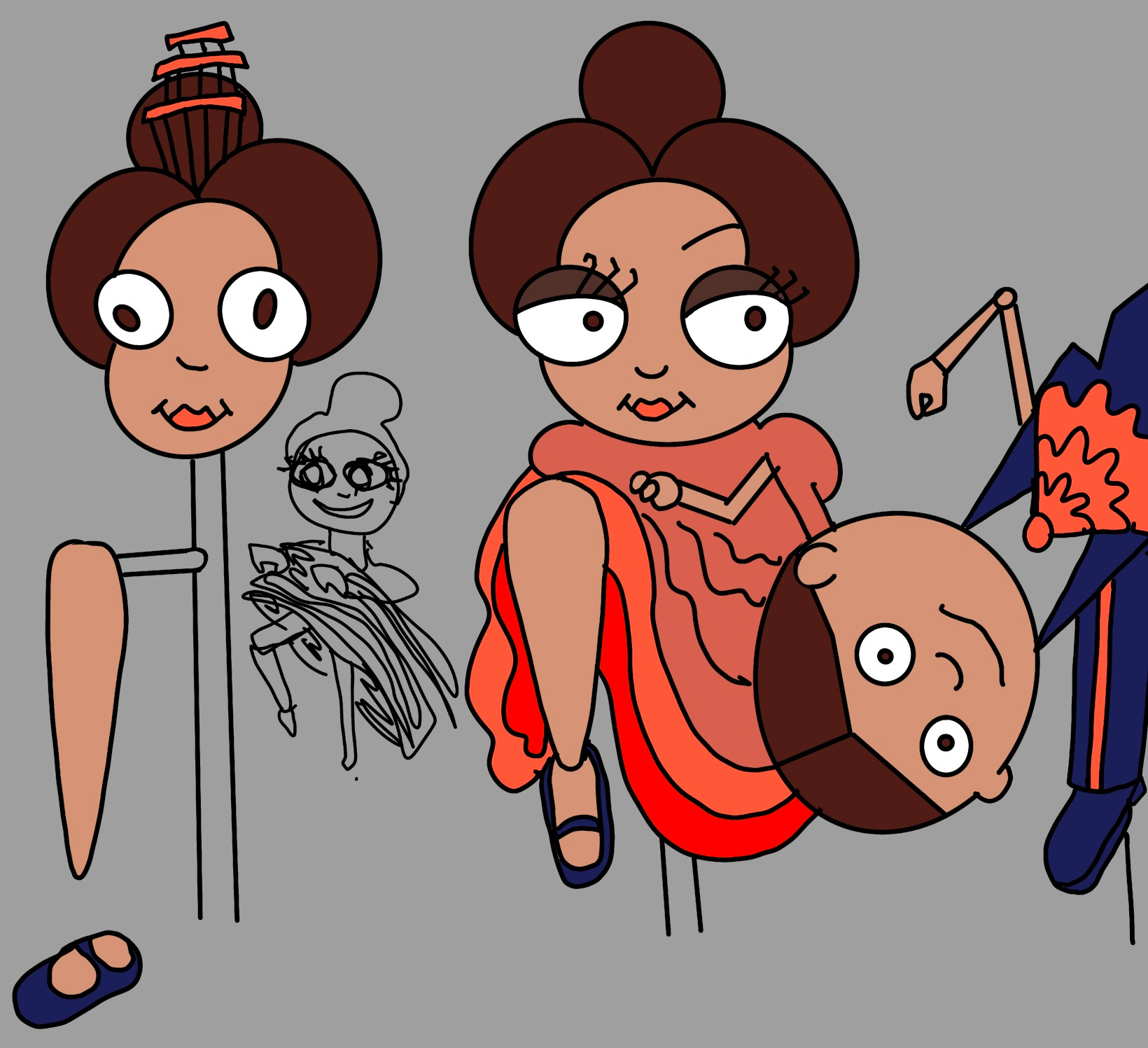
The mechanical puppet-children swung around her looking dead and half-dead and she knew she looked no better. Her entire right side was a useless mass of bruise and torn tissue. The other door was on the other side of the river, which would be very difficult to get to in this condition.
Now that some lights were on, she could see a path through the whirling robot children. She could also see that the river was filthy, murky, and obstructed with debris and two collapsed boats — boats close enough to the surface to use as stepping stones, an easy trot across if her body weren’t so damaged. She might even be bleeding internally. She thought of all the perpworld games she’d played where her damage numbers crept high — it’s almost always a sign you’re about to lose, a sign you’re about to “die.”
She heard a boom and looked up again at the square of sky. It was dark gray now, and heavy raindrops were falling through onto the spot where she fell. “My gun. I dropped my gun.”
She stared hard in the area where she landed, crouched to look under the dolls’ feet as they swept by, but she couldn’t see it. The swinging children on their mechanical tracks could have knocked it in any direction, in multiple directions, even dropped it right into the river. She watched the ways they moved and tried to imagine how a rifle would slide and spin, nudged by their dances, but everywhere she looked, no rifle.
No rifle. Sofi yelled every obscenity she knew as loudly as she could, so that her shouts echoed through the room and over the sound of the singing and the grinding of the machine. She went back and sat in the control room, drank some water from her pack, then strapped it back on and took a deep breath and started hopping and hobbling past the dancing dolls, towards the fake river, towards the last door that might also lead nowhere, or might offer her a chance to continue to live.

Chet heard the campsite before he saw it, the taut tap-tap of rain on its shining waterproof surfaces. He stopped several feet from the edge of the clearing, deep in the steamy leaves where no camper would see him. It was an outlander’s campsite, a “Canadian” campsite, with tents and equipment crafted by the dark magic of science and industry. Bradidiah stopped beside him, also silent in amazement. They had come across such material before, dug up from the Stinking Hill of Treasures, or floating in the Sea of Houses, but they had never seen such items so new, so brightly colored, so fully operational.
Bradidiah gestured to his friend with a finger, and Chet saw: the outlander, a man of pale and sun-sheltered complexion, lay dead at the entrance to a tent, his blood already soaked into the thirsty earth, which now swallowed large drops of rain as well. Bradidiah stood. “She was here,” he said. “But she is gone now.” Looking up he saw one raven land, then another.
“Look: she has taken his hands, and…”
“Yes, she has taken his head as well. This is what awaits us if we do not strike first.”
“He did not even struggle.”
“She must have bewitched him.”
“There are weapons in that tent — I can see them. He did not even try.”
“She tricked his mind. He believed a friend came to him. Someone harmless. We will not be fooled.”
“Listen!”
They heard movement, fast movement, coming towards them through the rain. The ravens overhead cawed to one another. Chet crouched towards the bushes but stopped when he saw Bradidiah slip into the tent where weapons lay. In that moment of hesitation he inhaled deeply. Her scent, so clear before, had become yet more faint. “I do not believe it is her, Bradidiah,” he said as his friend emerged holding a pistol and a machete.
And it was not her: it was a man running blind from rain and fear down the narrow path to the campsite. He was a soft man, curled in upon himself, light-skinned for a city person, but still a city person, unwise in the ways of the wild, his eyes still squinting in his sun-shocked face. From such a man Bradidiah and Chet knew they had nothing to fear, which aroused Bradidiah’s suspicions. “It is her, come in disguise. This is how she tricked the other.”
The man shouted “Pierre!” as he approached head-down against the rain and heavy-footed through the mud. He looked up from his feet only when the tents surrounded him. The dead man on the ground, the two forest men standing nearby. He stopped, so strangely — for he did not scream or jump or retreat. He seemed strangely calmed by the sight of the headless, handless dead man. He exhaled. He could see that Chet and Bradidiah were there, but he did not look at them. He raised his hands to welcome the rain, he opened his mouth to the sky:
“Fifteen years ago I watched a man stab my mother between her legs until she died. A white man, like you. I was a coward, I was a child, I hid until he was gone. When I touched her body, she gave me a new life: I was reborn the child of that knife. I raged through your villages. I killed a man who resembled my mother’s killer. Then I killed three more. Four lives ended at these hands. Since then I have felt regret.” He looked down at the two men watching him carefully just a few feet away. “Though perhaps not enough regret. I have felt righteous too. But the war is over now. The City of Towers is filled with children who have never seen their mothers murdered, never seen a brother or sister lying dead in the street.”
He fell silent again, and still they watched. Rain fell over all of them, pouring down their skin, soaking their clothes, dripping from the tip of Bradidiah’s downturned machete, and from the hand that held the raised handgun. Chet stepped forward and touched Bradidiah’s arm. “I do not think it is her,” he said to his friend.
Bradidiah could not be so sure. He opened and closed his mouth. He narrowed his eyes.
The man took a step toward them, his palms raised, mouth opened in the breath of reason, and Bradidiah fired, the gunshot like an explosion through the rain, and Chet crouched and hid within his shoulders even as his fingers touched the Mouse at his heart. The ravens took flight without voice. The city man still stood: surprised now, as though he wondered what he heard. And now he clutched himself in pain. Bradidiah, horrified, fired again. And again. He wanted to end the agony of watching this other man know he would die. He emptied the weapon. The city man fell and struggled. It did not take long. The ravens returned. Now two men lay dead.
“If it had been her, the spell would have broken,” Chet said.
“It was not her,” Bradidiah said. “He was to be another of her victims. We have saved him from that. Now he is my victim. Once again I have earned my curse.”
“This path — this must lead to her. Let us take more weapons and follow it.”
“Yes, let us go to her.”
“We will destroy the witch and end this,” Chet said.
“Or she will destroy us, and that will end this too.”

Author’s note: I know what you’re thinking — you’re thinking, “Amy, why does that puppet look like Stewie from Family Guy?” I’ve been asking myself the same thing. If you asked me to draw Stewie, I’d have given it a football shaped head, so trust me, it wasn’t on purpose. And yet the resemblance is unmistakable. All I can say is I was trying to make the doll look CREEPY, and in something like “convergent evolution” ended up in a Stewie place. Drawing is weird that way. ¯\_(ツ)_/¯