
The Machine and the Mindset (Mostly the Machine)
On Rushkoff and Kingsnorth

For me it started with “divisiveness” — and I have not moved on.
People started self-sorting into enemies-groups with maniacal energy, and all I could think is that, if we’re being divided, we’re probably in danger of being conquered.
So what’s going on? The answer is psychological and political and social and technological, and exploring this subject has been a journey that has taken me thru more books than I can possibly list here. But the two most recent are achingly relevant and fairly complementary: Paul Kingsnorth’s recent Against the Machine, and Douglas Rushkoff’s 2022 Survival of the Richest.
Both books talk about something complex and difficult, and both of them coin a phrase to make it easier. Kingsnorth talks about “The Machine” (which as the title asserts, he is AGAINST) and Rushkoff talks about “The Mindset” (which, btw, he also is AGAINST). It might be oversimplifying to say that Rushkoff is railing against “The Mindset of Kingsnorth’s Machine” — but not by much.
I recommend both of these books to you, but especially Kingsnorth’s, because it made me think deeply about some uncomfortable things (which I’m going to share here). I am a person who enjoys reading perspectives that I might not entirely “agree” with. I don’t do this to “hone debate responses” — I am NOT a rhetorical warrior studying “enemy’s tactics” for my advantage. Far from it. I’m genuinely interested in gaining insight about the world from someone whose perspective is very different from my own.
For example, Kingsnorth has some really viscerally negative opinions about COVID vaccine mandates and vaccine passports. That’s not something I’ve had to deal with, because I live in the USA, where enough people are loud and noisy and ungovernable, and there never really WERE mandates or passports, for most people. But he lives in a place where lockdown rules were brutal, and, as a British person, he might’ve even been likely to get stuck by the AstraZeneca vaccine, which we now all know was dangerous! So while his point of view isn’t mine, I see it, and I sympathize with it, and I get how frustrating it must be for him to be dismissed as a crank.
If you’ve been divided into a sect (and how could you not?), something in these books will offend the sensibilities of that sect, no matter what sect it is. But I think we all have the power to rise above that.
I believe that Truth is a real thing — it exists, it is definite, it is not subjective — AND it is NOT unknowable! It is visible to all of us, in part. But Truth is like a diamond of infinite facets, and we mere mortals are each only able to see a facet at a time. Live long, rove far, experience much, and you can understand more of Truth. But also by talking to others, listening to others, opening our minds to others, we can understand more of Truth than our singular perspective would permit with even the longest life of adventuresome roaming. THAT is why I enjoy reading perspectives that might be distant from my own — because our fellow humans have a very different view of Truth, and seeing it thru their eyes gets one a little closer to understanding MORE. (Understanding ALL being, of course, impossible.)
So I encourage any reader to be open minded: the IDEA that (for example) transsexuality is philosophically linked to trans-humanism and reflects the broader reduction of humans to “biological machines” with “parts” that can be changed out for other configurations IS interesting, and it’s an idea that I think enriches your understanding of transsexuality no matter who you are or what you believe.
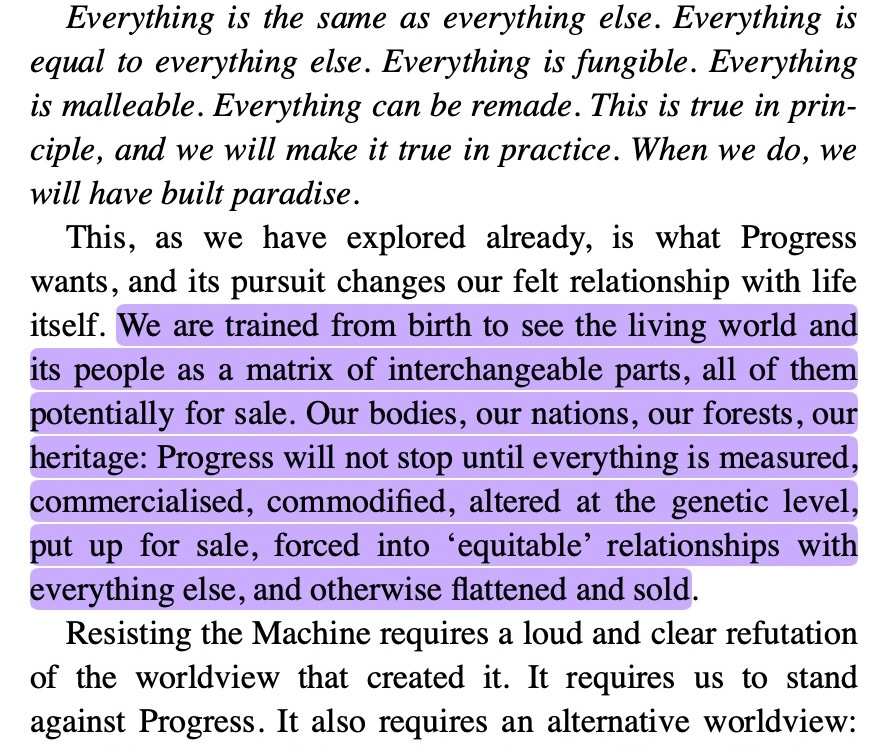
I will never tell another person what to do with their body, and I don’t think anyone else should either. If you want to change your body, that’s your business. But we live in a culture, and cultural forces, cultural “voices,” speak to us, and one of those voices might be saying that our physical form is little more than the meat-avatar representing us on the sub-par “platform” we call IRL, and that until we can upload our consciousnesses into a digital realm of unlimited choice, we should RESENT the stubborn imperfection of these human bodies, which age badly, get sick and die, and can be embarrassingly weak, or unsymmetrical, or uncoordinated…
And not only should we resent all that, but we should resent that we were given no choice as to the biological SEX of these avatars, they were just randomly assigned by the chaos of nature, and we’re stuck living the consequences, WHICH ARE MANY. Nature is the problem. Technology is the solution. That’s “The Mindset.”
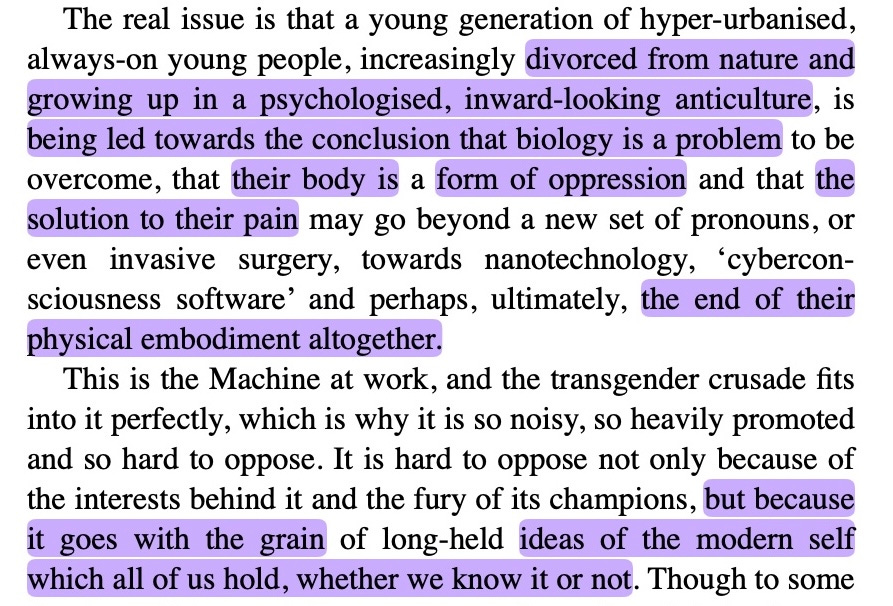
And “The Mindset” says this problem should be fixed by “The Machine,” with its commercially available technologies: better living thru chemistry, surgery, and augmentation. Whereas certain humanist authors, readers, and plain ol’ people milling about the planet Earth might feel there’s grace in accepting your body however it was born, and strength in facing that all that live are subject to the ravages of time and misfortune. We become wise and capable of moral courage when we live in accordance to this truth: that no one here gets out “alive” — the final chapter of every living story is death. This truth should make us careful, and tender towards one another. Yet more often we are divided. Yet HOW we are divided also “goes with the grain”:
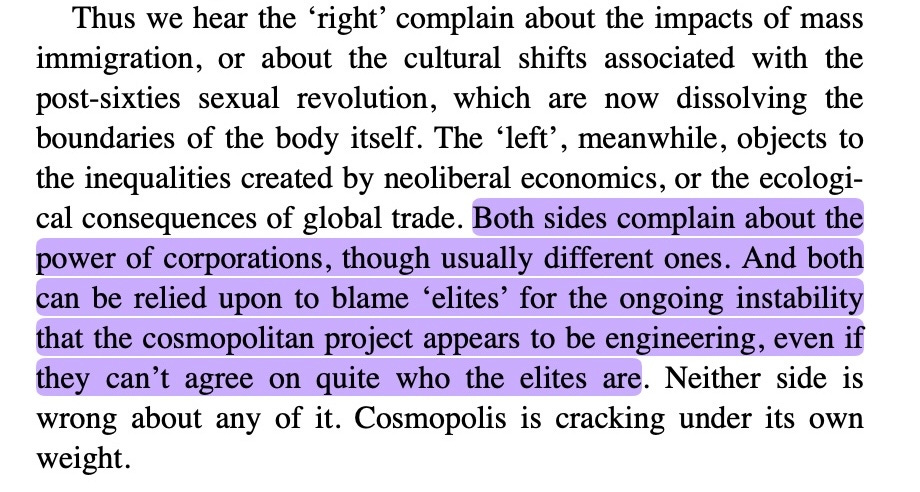
I really like this perspective, that “neither side is wrong about any of it” — because I like common ground. I like finding Human Nature persisting Universally. And the idea that two opposite “sides” can “neither be wrong” suggests that looking at the entire situation from a new angle is required.
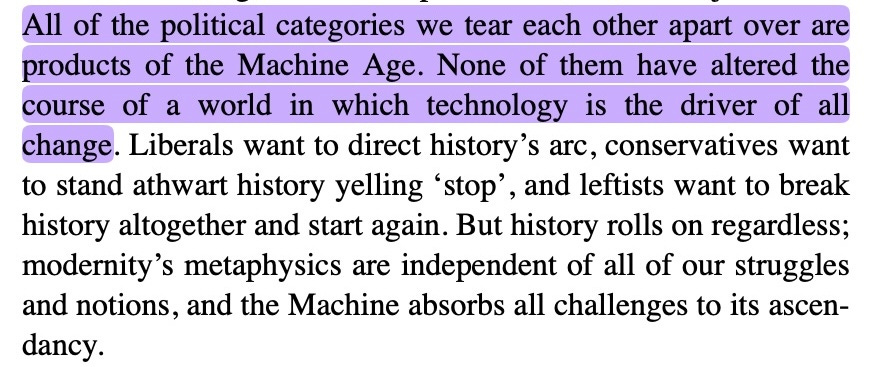
This suggests that we’ve all sort of been “had”: in our attempts to be good people, good humans and good citizens, we’ve bought into playing certain “roles.” These roles have divided us against one another and therefore weakened us against the bigger, exterior brute force that wants to break us all. And all of the roles are in service to the story of a hero who is rarely doubted, and who ALWAYS gets the treasure in the end. “Progress.”
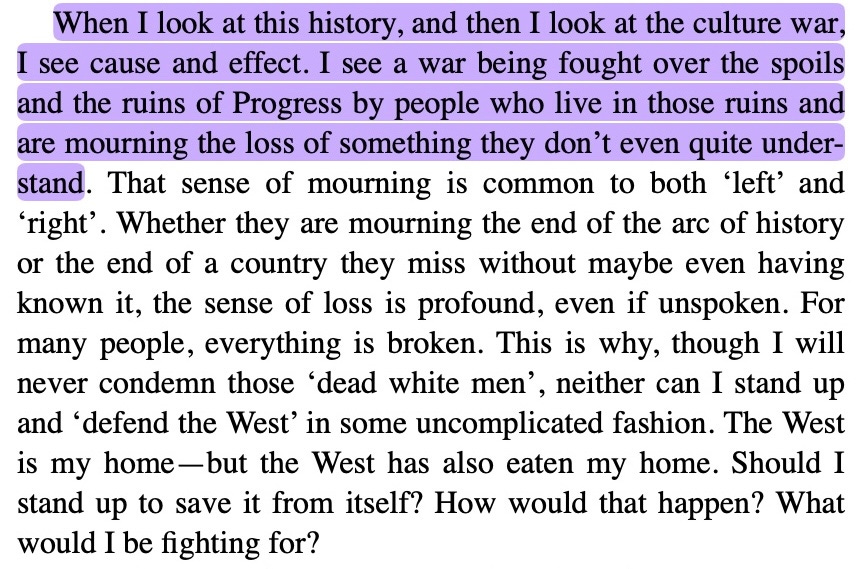
He gets further into this idea by describing how The Machine made itself in the countryside of England; where once there were commons now there are stone walls and hedgerows, and people were driven from the land by poverty and desperation to work in factories. When he says, “The West is my home—but the West has also eaten my home,” he describes the conundrum you are in whether left or right or whatever: we want to be humans with cultures and traditions, but those patterns were bleached from the cloth generations ago.
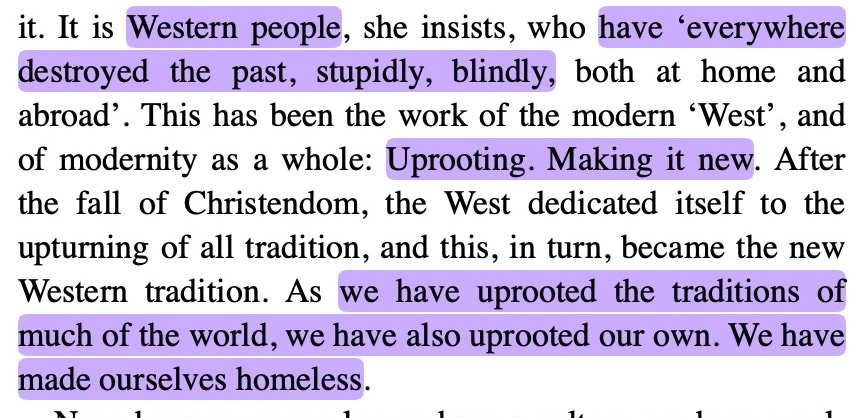
The homeless oppressors of the entire world? Weirdly true. We wouldn’t recognize our traditional songs or dances, we’ve lost the knowledge required to sustain ourselves by our own resources. We’re not just standing in “ruins,” we’re standing in the ruins of what was to be our home.
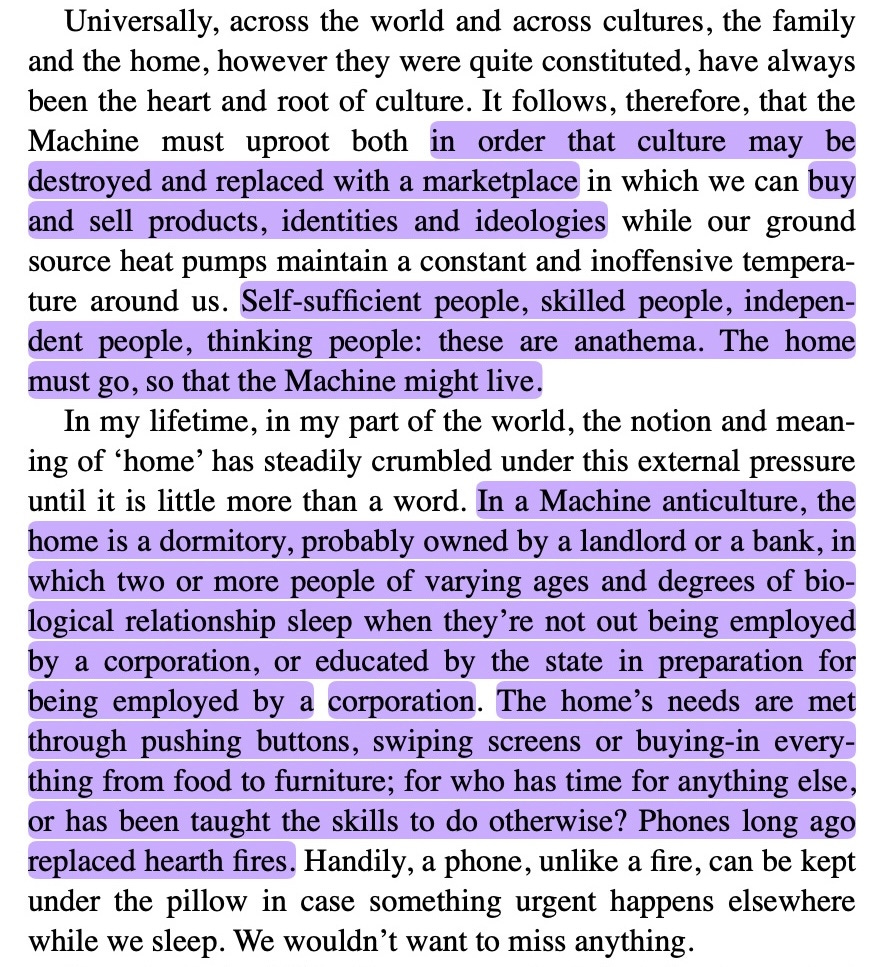
So at one time, work and home were more or less the same place, because people worked that their home and family would thrive. Now the arts of life and the home are sweatshop industries in foreign lands, but here degraded to mere “hobbies,” and then commercialized as hobbies you have to buy into. The impulse to get close to nature is quickly redirected by the machine into “gear” and “technical fabrics.” You want the woods, you get REI. You want the home, you get “Home Depot.” You want to sew, go to Hobby Lobby. You want to eat “naturally,” you go to “Sprouts.”
You’ll probably need to take the car. Gas up!
One of the ways in which Kingsnorth’s perspective is interesting is that he was what he calls an “Old Green,” that is, an environmentalist from before environmentalism being swallowed by The Machine. The first time I confronted this fissure I was a teenager, and I’d been persuaded to buy plastic shoes because they were “vegan” — no animals harmed. I told my aunt this and she almost smacked me upside my head: your shoes are made from OIL, she said. You’re wearing petroleum products on your feet! What do you think hurts the Earth more, an oil well or some cows?
[ I guess it would depend on how many cows, but I’m going to say oil well ¯\_(ツ)_/¯ ]
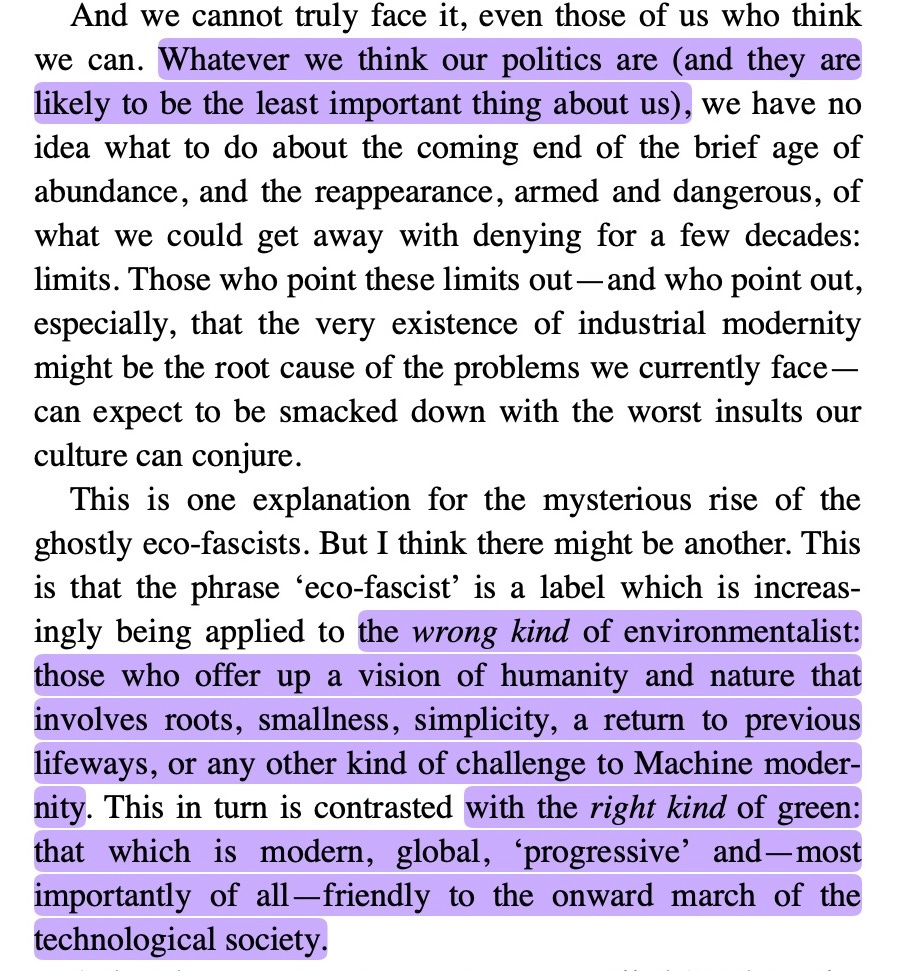
And he is right: our culture has moved from outright hostility towards environmentalists who, back in the day, were not buying much (or not much with “value added” which is where the real profit lies), to now, where it’s a whole new world! Today, environmentalists are a “growing market”! They need highly-processed foods, because no one wants to live on kale, lentils, and rice. And so the vegan diet is pre-packaged and frozen and sold at Trader Joe’s, part of the global supply chain, part of what keeps the trucks truckin’ and the cargo ships shippin’. The common thread he identifies is Progress, The Machine, the onward march of Commercial Technocracy. We’re allowed to define ourselves and our morals in any way, so long as it COSTS MONEY.
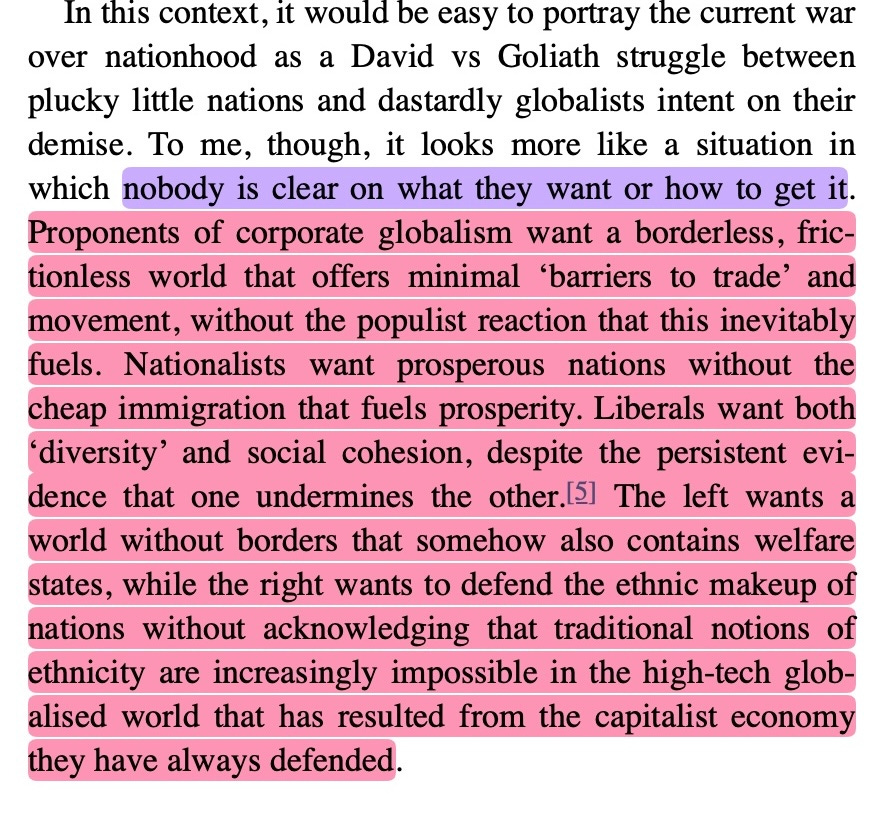
It’s almost like every position a person could have is leveraged by an element of the larger system that the same person can’t do without — or thinks they can’t. At least among these categories as scripted.
So if we’re following the script, we might find it inconvenient to be reminded that our solar cells can only be created at great carbon-cost and with the highly polluting mining of rare-earth metals. But if it confuses our categories, maybe that means our categories are wrong? Maybe the solar cell industry and the oil well industry are two faces of the same beast?
The one idea that everyone’s bought into tho is that just curbing consumption, just burning less, eating less, making less, using less, is outright anti-social! You’ll have it both ways or you’ll have it one way, but you’re NOT allowed to refuse to have it any way at all!
There is a part of Kingsnorth’s book that I’d like to screenshot and share with the others, but I really can’t pull it out of context without PULLING IT OUT OF CONTEXT. And yet it might be the part of the book that struck me the hardest, the part I think I was least likely to read anywhere else. So I’m going to describe it.
He’s talking about other thinkers who have faced these questions, and describes an Irish dude named Moriarty (a thinker, former-professor, and a writer of books), who felt that Europeans needed to explore their own myths. He admired cultures that have not yet been bleached out by the machine, that still had the texture and color of those connections. He argued for journeying thru the real-world stories and dreams of our mythology to find that connection. Here is Kingsnorth:
What Moriarty is seeking throughout Dreamtime, and in all of his other work too, is access to his own aboriginality; a way of learning how to be indigenous again in the age of the Machine. Words like ‘indigenous’ tend to make people twitchy in the West today, unless we’re talking about tribal people in some safely far-off place, and it’s not too hard to see why. Downstream of the Holocaust, we are still highly sensitive to notions of rootedness, land and belonging. Some people hear ‘hearth and home’ as ‘blood and soil’; others just pretend to for their own political gain. We should certainly keep our ears pricked up in this regard, and avoid making idols of nations or cultures. But we should remember, too, that our twenty-first century reluctance to talk about who and where we are has provided useful ammunition for proponents of Machine modernity to demolish every limit, tradition and boundary in sight, while painting those who object as fossils or fascists.”
“Access to his own aboriginality” is a striking idea. Do I have “aboriginality”? If I do, could I “access” it? “Learning how to be indigenous again” is striking as well. WAS “I” ever indigenous? COULD I learn to be that “again”? I think Kingsnorth’s caveats about avoiding becoming Nazis is an important one, but the error people are making instead is of drowning yourself to avoid dehydration: we’re thirsty and we need to learn how to drink moderately from the well of the world that made us.
Being human in the face of the post-human world, means accepting that you cannot purchase your way out of your humanity, even tho that solution is being heavily marketed to you.
Being human in the post-human world means choosing to be more human, because the cultural “default” is to be less human at every opportunity.
Being human in the post-human world means rejecting the shape of the categories and roles that we are presented with so that we can find common ground among them, or see them from new angles.
Being human in the post-human world means, I think, seeking out what one’s “aboriginality” and “ingeniousness” might mean, not just for you as an individual, but for YOU AND people connected to you.
Being human in the post-human world means REBELLION: Kingsnorth says in his book at one point, “Rebellion is necessary, if we are to remain human at all,” and I agree. Because going with the grain or flow of the world means getting ever farther from our humanity.
Amy, your list of what it means to be human in a post-human world reads like a rule of life. I want to keep it close — maybe stapled above my desk. I love this so much.
The “we’ve been had by the roles” idea is exquisitely painful in its truth. That realization that even when you think you’re trying to be a good person, you’re still mostly following a script the Machine handed you. The way you connect divisiveness, “progress,” and environmentalism-as-market into one story of capture feels bleak — but it’s honest-bleak, not cynical-bleak.
The section on “access to his own aboriginality” is pinging around my brain like crazy. I love how you use the language of land and roots without letting it slide into blood-and-soil thinking, and instead turn it into a genuinely gorgeous question: how do we become more human with each other where we actually live — in bodies, in limits, in relationship.
I keep wondering what resisting the Machine looks like in the "small" — in care, in work, in love — when we aren’t really able to opt out. That question has been coming up again and again for me lately, especially with people I’m close to.
Thank you for writing this.