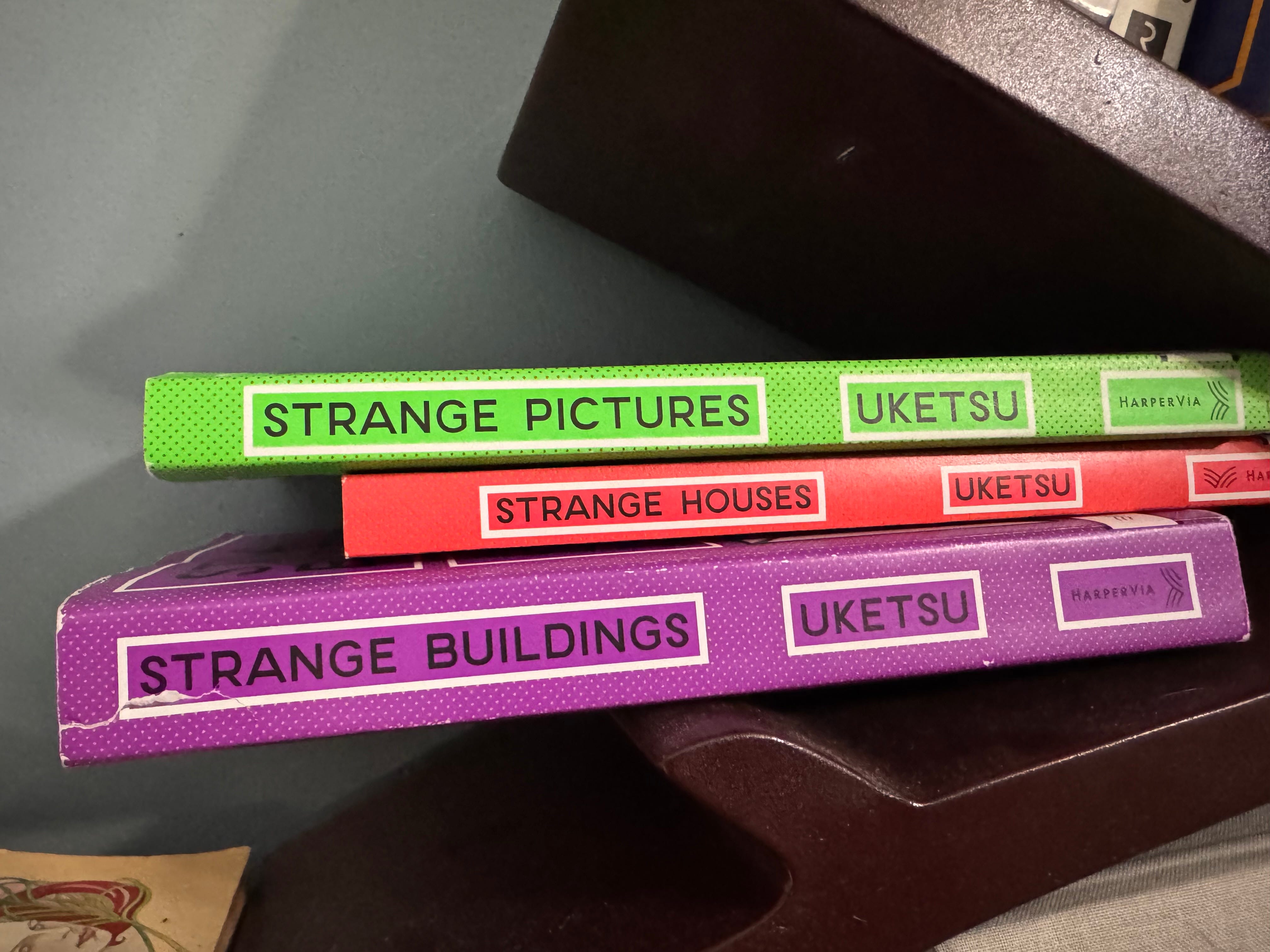
Strange Books
Metropolitan by Walter Williams

Lately I’ve been enjoying strange books.
These books are not “strange” in that performative way some books exercise strangeness, that purposeful, elegant weirdness that manifests in white space and can be measured by rules — literary strangeness that is also erudite and methodical, that seems, if I may say it, aware of, and defensive of, any future accusations of “cringe”…
I have enjoyed those books in the past. But lately I’ve been enjoying books that Ride The Cringe, that are so bizarrely unbelievably submerged into themselves, you marvel that the writing is un-embarassed. Reading these strange books is an antidote to something I’ve been feeling, which is best described as “hemmed in by expectation” — I’ve been writing long enough that even if my audience has never read a past-word-o-mine, I still feel the weight of all my past words and I wonder if the next thing I write is (by them) circumscribed.
I don’t want it to be circumscribed. I want my fiction to go off the rails. The rails I am on, I am on them because once they were the rails that interested me, but they have carried me within view of another country, and I need to hop skip and roll if I’m going to get there. My landscape of destination doesn’t have rails or roads… only poorly kept paths. Trails walked by gusts of wind, borders kept by rivulets of rainwater.
The most important practice of writing is READING, of course, everyone knows that. The best writing advice is “when in doubt, read.” Reading stirs the writing-pot. Reading lifts all the fascinating bits to the surface. Especially if you’re reading something that excites you.
These books have excited me because they are daring and naked and extreme. They are weird, they are strange. They are shameless. Here is one:
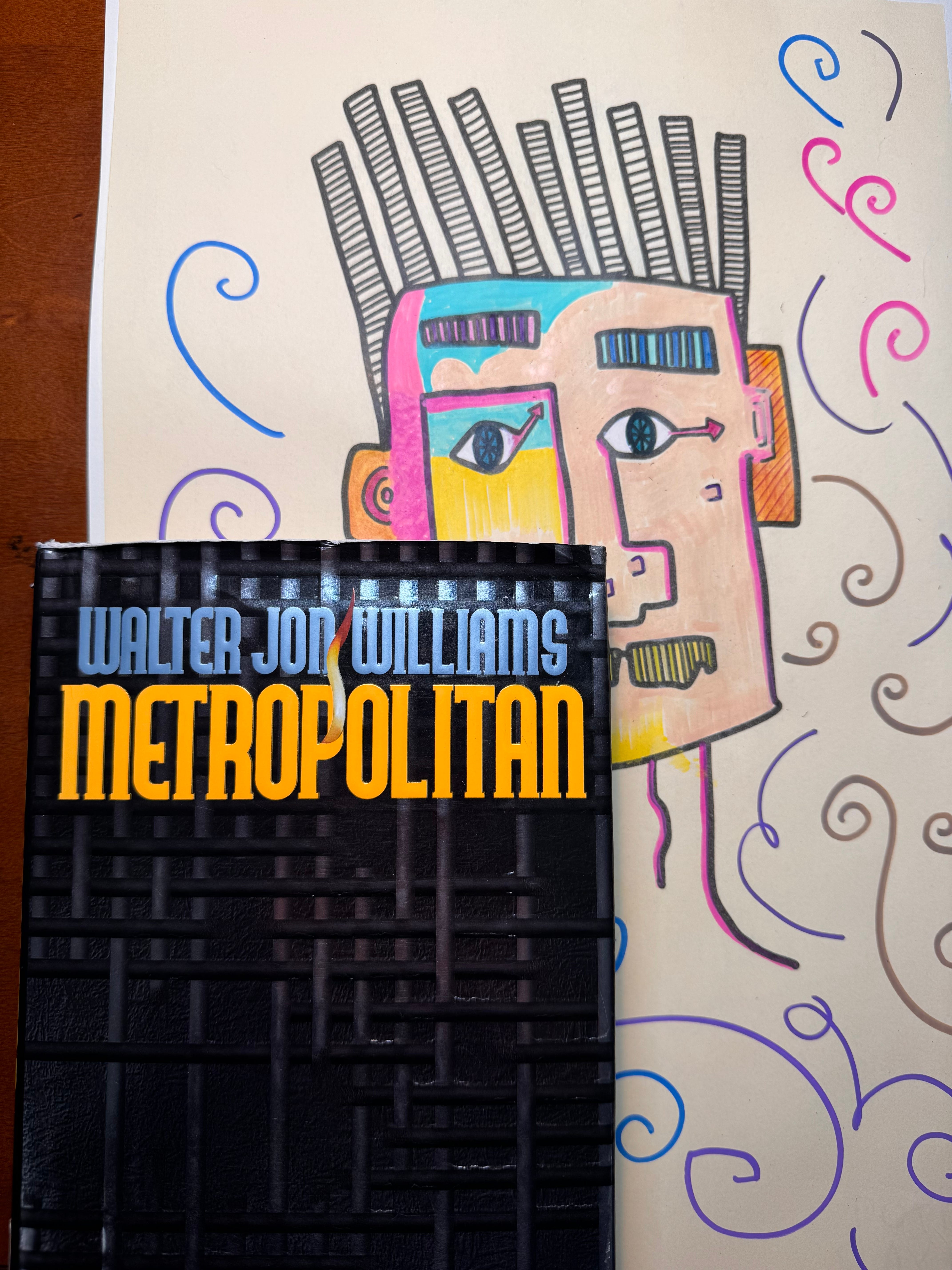
Metropolitan by Walter Jon Williams is a “science-y magic” fantasy novel, where the “magic” is a metered natural resource managed by a public utility, and people have to go to college to learn how to use it — but once you’re in class, they don’t just GIVE you the magic stuff to learn with, it’s expensive! You have to bring your own — so only rich students can afford to “study” it.
Magic in this story is tied up with celebrity and mass marketing, in a really gross way — the magic stuff makes people stay young and attractive and healthy — almost as a flex, all the richest people chain-smoke because they can never get cancer. It also gives them endless energy — the party never has to stop. Poor, ordinary people need sleep and get sick. The rich make themselves well-known and glamorous and then use that fame and glamour to fleece small sums (which add up!) from the millions of poors, who are always running to catch up. I have often wondered how much poverty could be cured for the price of a single Super Bowl, and while this book doesn’t quite ask that question, it shows a world in which magic is used to create otherwise meaningless profit-churning spectacles despite the corruption of an unequal society, which is riven by class conflict and divided by race and ethnicity.
The main character is a member of a minority that is believed, by the majority, to be thieving and crafty, and they are mostly poorer and more likely to be tear-gassed by cops or attacked by drunken gangs on the street. Yet the main character IS also thieving and crafty, not that any of her relatives are — it’s really just her — but she grapples with the idea of fulfilling a stereotype about her people, even as her actions both morally repel and excite (and enrich!) her. At first she’s just a striver, a climber, but then she stumbles onto a SOURCE… an unmetered, unknown, off-the-map SOURCE of this impossible power. Before she’s done, she’ll cause mass death and end up not just rich but empowered and high-status, as one of “the good guys” — and she’ll experience sex enhanced by magic, a many-thousands-of-dollars orgasm, like a cherry on top.
The whole story takes place on what seems to be a future Earth that has been sealed in by something like a reverse-Dyson-sphere if that makes any sense — this world has a literal ceiling, Earth is trapped in a ball, and that gives the story two very interesting effects: first, it makes it seem completely cut off from reality as the reader knows it; and second, it makes the world full of peoples and societies and classes seem very small and trapped together — and therefore foolish, because they’re attacking each other when clearly there’s a bigger problem going on all around. There are ancient legends that once there were light sources called “sun” and “moon” up in the sky, and they have cartoonish childish ideas about what that might have looked like, because they all live under a non-stop fluorescing surface that they cannot pass or escape, not even with their amazing magic.
This world is also peopled by individuals and groups who have been formed by the magic into something non-human. Maybe they’ve been made into something glorious and godlike, or maybe they’ve been made into something slimy and hideous, or maybe they’ve been made into ghosts that exist in the flow of this powerful magic-stuff and seek only to possess a body, which they will burn up quickly, in a desperate and murderous bid for a fleeting taste of corporeal form. Meanwhile the flesh-and-blood humans want to plug themselves into the power stream so they can project their “animas” and fly through the air, observing the real world secretly, invisibly, until they WANT to be seen, at which point they can manifest themselves as mere visuals or they can alter matter and beat someone up, maybe knock down some walls.

And that brings us to the this magical substance’s ultimate purpose: WAR. The novel’s main character doesn’t seem to realize it at first, but the highest purpose of this POWER is not to make yourself rich, or energetic and beautiful, it’s not to make yourself famous, not to have amazing sex, not to eat delicious foods that are out of reach for ordinary people, not even to transform or fly, but to CONQUER. And not even just to conquer a physical landmass — to conquer the truth. To be able to manipulate how the public receives the events you’ve orchestrated so that you control the “story.” The ultimate flex in this novel is to be able to say to a planet full of attentive, admiring eyes and ears that the people who died lost their lives for a good reason, and now in order to honor their memory the whole country must now do A, B, and C.
This story is nutball crazy when it comes to the physical sciences, and even compared to more traditional stories of magical beings, this story makes an unexpected (but clever and true) swerve into socio-economics. But when it comes to our understanding of POWER and how humans use power to gratify themselves and hurt others and convince themselves that they are justified and great — well, this book might as well be proposing a solid set of physical laws that pertain to human behavior. And I’m not sure there was a way to write a story about that that wouldn’t have been gut-wrenchingly depressing, except by making it so very, wholly entirely strange. The fantasy elements and the bottled-in Earth are part of what make the truth of this story comprehensible, I think.
Its strangeness leads to its solidness.
Thanks to Max Read for making me aware of this book’s existence.
Next time, Uketsu