
Grades are Dumb
And so is Harvard 😛

In my quarter century (!!!) of teaching college, I have had several students over the years request that I “grade on a curve.”
I’m about to get spicy.

Because they learned this phrase from popular culture, where it apparently just meant “grade inflation,” I would have to explain to them that, as A-grubbers, the LAST thing they would want is a teacher who grades on a curve, which should mean numerical grades are adjusted to fit a bell curve in which roughly 50% of the students are assigned a “C” and around 15% must receive a D or B, leaving something like 10% to receive an A and 10% shafted with F’s.
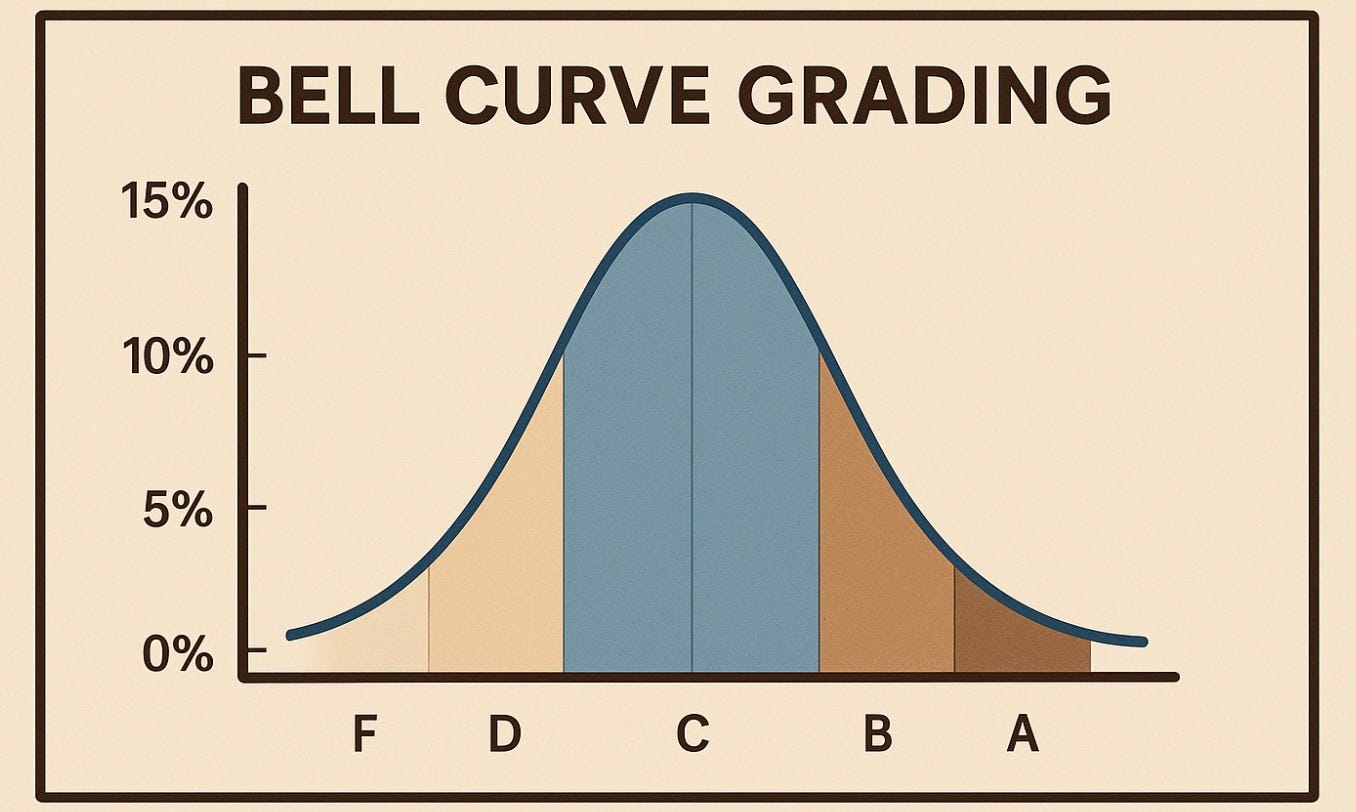
There are theoretical ways of looking at this where you might decide this is a good thing to do, but to an A-grubber, the idea that A’s would become a “limited resource” — that there are just a few A’s to be had — and that they will have to COMPETE for one, against others like themselves? That is a nightmare indeed!
When I was an undergrad I majored in the sciences before switching to Writing, and I had a magnificent Organic Chemistry professor named Dr. Cyril Parkanyi, who DID actually grade on a True Curve and it DID actually benefit most students, but only because he was giving tests in which the median number of actual correct answers given would hover around 50%. I will take a moment to brag that I never got below 92% correct on a test in organic chemistry. I frickin LOVED that subject, and I loved that professor. He would show up in black socks and Birkenstocks and casually teach us, with a musical accent that had waltzed straight in from Prague, his lectures frequently punctuated by the phrase “as you know,” which, bless him, most of us did not!, how to make hard drugs in the lab (maybe just to see if everyone was paying attention?) and then erase the chalkboard before any laggards could copy it down. Ah, the days before smart phones! Don’t believe the hype: things really were better back then. More interesting things were prone to happen!
So A-grubbers. They’re a thing. Sometimes they have good reasons, like if their GPA falls below a certain number they no longer receive a scholarship without which they cannot afford college at all. That’s a good reason! Often they just weep and say, “but I’ve never gotten a B in my life!” In any case, grade-grubbing warps the mind — I recently had a normally very excellent student who’d become overwhelmed and fallen behind on things look me square in the eyes and ask me what was “the bare minimum” she could do to earn an A for the course. While I tried to swerve the conversation back into better territory, it bothered me for a WEEK. “The bare minimum to get an A” is a statement I would call “paradoxical” at best.

At the same time, I am aware that grades do not REALLY mean anything. Grades are not your worth. Grades are not moral. A person could have a higher GPA because they are a good-looking star athlete and certain girls in the class are willing to do all their work just to be seen TALKING to them. Another person could have a lower GPA because in addition to college they work full time at a hospice center and also volunteer to counsel homeless people at their church. Neither of those examples are made up, by the way. At the same time you could have two students, both doing all their work faithfully and honestly, and one gets A’s and the other gets C’s, the A-getter is an idiot who stumbles through life making enemies and the C-getter becomes a cornerstone of human society, and this result would surprise no one.
I learned to teach college classes as part of graduate school. They admitted a bunch of graduate students in English and, in exchange for tuition, most of us taught two “freshman composition” courses. I literally taught my way to an MFA! One of the activities when they’re teaching you to teach is called “grade norming” — a large group of people all read the same example student essay (usually a real specimen), and everyone decides what grade they would give it. Then there’s a conversation where people explain why they gave it the grades that they did. There is always a spread of grades. The goal is to get everyone closer to the same page, to get the easy graders and the harsh graders to realize that they are outliers, so they might moderate their judgments towards the middle. But the effect is to make everyone realize that, dude, this is REALLY subjective.
One of the students in the class a year before me had a breakdown when given their first stack of student essays to grade. Like so bad, they had to leave and get treatment. Other grad students had to grade their class’s first assignment at the end of the semester, and when this person returned to grad school, they were not allowed to teach anymore, but I did get to know this person and thought they were really nice and smart and interesting. It was also very clear why this person had broken down in the face of doing something so arbitrary as assigning grades: because this person had been a philosophy major trained to look at things very logically and with precision. AND they had been trained by upbringing to believe that grades actually MEANT something. It’s like believing in Santa one day and the next being handed the hat and beard and a sack of candy canes and coal — these are the children you must judge, naughty or nice?
I did once have a cousin tell me that when I gave students an F I was “ruining their lives” — no one’s life is ruined by an F, I told him, but he was not convinced. I explained that at the university I taught at, an F was just an opportunity to redo the class, because if you earned a better grade the next time around, they would REPLACE the F with the new grade. A mulligan!! But it seemed to him I was still ruining lives. I think to him the emotional impact of failure would be so devastating that the idea that you’d go back and do it over didn’t sound like an opportunity, it sounded like a nightmare.

Grades are one of those things like MONEY or RACE or GENDER — they are social inventions of human interaction — tied to things we find meaningful, but fundamentally abstractions invented by and agreed upon BY an abstraction (“society”).
So one is tempted to dismiss all of them as “a game” and say they are “not real” or are “performative” — but nonetheless they have a real effect on your life. Money IS a game, but it’s a game that can starve you or leave you without needed medical care. Race IS largely invented, but others’ perception of yours could affect whether people will be nice to you, or even talk to you. Gender IS a performance, but how you perform it in the eyes of others WILL determine whether you’re seen as a leader or a loser, a queen or a crone. None of these things are fair, moral, just, right, or logical, they simply ARE. And that’s how it is with grades. Grades are fiction — fiction that affects your life.
I think it’s really interesting that Harvard has decided to limit the number of A’s. If you’re going to perform a cruel experiment on a bunch of young people, by all means make it the most privileged and entitled young people you can find!!
The stated goal is to make HIGH grades more meaningful by making them more scarce — but this also means making students compete for them among themselves. Imagine if a country imposed a maximum number of super-rich. Like there can only be 10 people in the country in the top 1%. Anyone who fails to outcompete the top ten gets a tax penalty that shunts them well down the scale. Imagine if a municipality limited the number of marriage licenses: we can handle 18 weddings a month around here, no more. If you don’t make the cut, you’ll have to apply next month. I’m just saying, imagine what it does to people’s brains when the things they need to feel successful are arbitrarily limited.
We know what happens when the limits aren’t arbitrary: there’s only so much gold on the planet earth, but the demand for gold will vary by the number of humans alive and their industrial and decorative needs. You can’t make more gold, and so the tragedy of gold is that if you increase demand enough, it will rapidly become “smart business” to incinerate six million people for their wedding bands and the gold fillings in their teeth.
So we can’t increase the amount of gold, but we can unhinge our monetary systems from the amount of it available, and we can recycle it, find alternate mechanical processes so it is required less by industry (and dentistry), and make tungsten wedding bands a hip new thing. Enough people get murdered, you do what you gotta do.
The Harvard experiment is like deciding to tie a currency back to gold just because you want that currency to MEAN something — Harvard is making it so that A’s are now a limited resource. Suddenly there’s a kind of logic in getting the smartest guy in your seminar plastered the night before the test. You need to take that MFer OUT — incinerate him so you can get the A he’s got buried in his guts.
“Getting a guy plastered” is the least horrifying example I can think of. But there are lots of ways of undermining a fellow student. You could just socially shun them for being too smart — NERD! Ostracism and low self esteem lowers academic performance. You could sexually assault them — that tends to fuck up people’s GPA! Often they drop out of college completely! You could drug them — did you read about the guy in France who was sneaking diuretics into women’s drinks while he interviewed them for jobs? Some of his victims were so humiliated they gave up on their careers! There are other options: you could just turn off their alarms so they wake up late. You could bully them online, try to make them feel unloved and worthless. You could spread rumors to create havoc in their personal lives. Or you could wipe your ass with their toothbrush to get them sick… I’m not trying to give anyone ideas here, I’m just pointing out that if you have a WHOLE CAMPUS of highly ambitious young people who have never gotten a B in their lives and you tell them that only 20% +4 students in the course can possibly earn an “A,” they will quickly look around them, do the math, and figure out who “the problem” is.

So is grade inflation really a problem?
Or is the problem that grades are so arbitrary?
Or is the problem that grades are a fiction but nonetheless affect people’s real lives?
Or is the problem that there are limited “elite opportunities” — eg spots at Harvard — and people have to compete to get them?
Or is the problem that humans can be greedy and cruel and will hurt others to get what they want — and we amp up that sad fact of biology when we have conditions of scarcity?
“The problem” can be shifted from place to place, and I’m sure as soon as the 2nd student dies because they were seen as a threat to another student’s A, Harvard will repeal the policy, but in the meantime it’s worth thinking about how dumb the whole system is.
There are two sides of teaching, as we know it: the mentoring side, and the gatekeeping side. We expect the same person to perform both roles. The professor attempts to cultivate learning in students, then the professor assesses the students to see if the garden has produced. Into this difficult balance, Harvard has introduced a new wrinkle: only the top 20% +4 cuts get to go to market with “choice” and “prime” slapped on their package. The rest fear they will be dog food.
Those of us on the outside looking in know that no one who goes to Harvard will be dog food — they’ll be fine. But THEY do not know that. They live in fear of slipping a notch lower than their nearest peer, and the fact that they’re still in the elite compared to us outsiders doesn’t assuage them one bit.
I do not and have never believed that Harvard students get a better education than students at other, less renowned colleges and universities. What they get is the name-brand endorsement and the benefits of connections with so many others who have the same gold seal. The longer I’ve taught, and it’s been 25 years now, holy moly, the more I’ve learned that the hardest most challenging education, with the biggest effects on a person’s understanding and ability, happens in the cracks and corners, among students who’ve transferred three times, students whose educations were interrupted by giving birth, students who went to war, students with full time jobs who care for elderly relatives — students who have learned and grown despite their guide being an overworked, underpaid, little-respected and little-connected community college professor — these are the people who have the most transformative experiences.
People whose parents went to Harvard, and who’ve always been expected to go to Harvard, who then GET to go to Harvard — well, for them, going to Harvard doesn’t mean much, does it? It’s like, the bare minimum, and it’s also like getting an A. A’s are baseline. It’s paradoxical when those two ideas are crushed together, but for many people that is their reality. And when people who have always gotten what they wanted don’t get what they wanted, sometimes they explode.
I think there’s every reason in the world for people who actually care about learning, growth, thinking, wisdom, virtue — all the things a college education can cultivate that don’t have to do with status and careerism — to avoid elite universities, and not just Harvard, like the plague. Whether for yourself or your child or grandchild, if you’re in a college-deciding place in your life, find that haven between the cracks and around the corner, the school people choose because it’s a place of learning, not “advancement.” And don’t give a crap about grades. Give all your craps about learning, and the grades will take care of themselves. My heart breaks with pity for anyone who wastes their youth worrying the difference between 92 and 93 percent. Life is so much bigger and better than that.

I received good grades (mostly A's) throughout my academic career, but never felt they signified anything other than being good a figuring out the "game". When a teacher was only "teaching for the test", I absorbed only as much as I needed in order to give the teacher what they wanted, but rarely actually comprehend the material. Fortunately, I had enough good teachers and intellectual interest to manage to get a good education despite my good grades.
When I was in my Ivy League college, no GPA's were measured. Grades were not ABCDF. They were only looking for whether you needed to take some time away for non-participation. I never felt I was competing with anybody. It was nevertheless a golden ticket when I finished.